
Chemistry-Biology Interface Program

Quantitative and Chemical Biology

Chemistry-Biology Interface Program
Quantitative and Chemical Biology
Graduate training in chemical and physical biology.
Our Chemistry-Biology Interface (CBI) training program in Quantitative and Chemical Biology (QCB) marries deep disciplinary training in one of six Ph.D. programs on the Bloomington campus with broad interdisciplinary training at the traditional boundaries of chemistry, physics and biology.
QCB fellow, Ria Kider (Gerdt Lab), authored a recent publication in EMBO Reports titled "Endocytosed lipids induce cell aggregation via filopodia retraction in a close relative of animals." The paper focused on evaluating chemical properties of lipid cues that activate aggregation in Capsaspora owczarzaki. Their work illuminate the molecular and cellular basis of Capsaspora’s aggregative behavior, with implications for the evolution of animal multicellularity and the transmission of parasites.
QCB fellow, Sandip Mishra (Lewis Lab) and Yasmine Zubi (Lewis Lab), authored a recent publication in Chemistry Europe titled " Mechanistic Insight into Conformational Control of Enzyme Activity by Genetically Encoded Metal-Responsive Switches." The paper focused on findings that establish genetically encoded metal-binding motifs can regulate enzyme function through subtle, localized conformational changes, providing a versatile platform for engineering responsive protein systems in synthetic biology, biosensing, and programmable catalysis.
QCB fellow Emily Erdmann (Hundley Lab) authored on a recent publication in RNA, titled "ADARs mediate distinct RNA editing activity and gene regulation in the Caenorhabditis elegans germline" The paper specifically focuses on profiling the editing activity of the A-to-I editing enzyme ADR-2 on transcripts in the Caenorhabditis elegans germline. Congratulations Emily on this work!
Chi-Tam Vo, a trainee in the Vázquez Lab, is authored on a recent publication in JACS titled “A Conjugated Oligoelectrolyte Exhibiting Room Temperature Spin-Correlated Radical Pair Character for Biological Sensing.” Their findings establish design principles for TICT-enabled molecules exhibiting qubit-like behavior that operate under ambient and biologically relevant conditions, with direct implications for quantum information science (QIS). Congratulations Chi-Tam on this work!
Austin Tedman, a trainee in the Schlebach Lab, is authored on two recent publications. He is co-authored on a review published in Expert Opinion on Drug Discovery titled "Recent developments in cystic fibrosis drug discovery: where are we today?" He also authored a publication in Journal of Biological Chemistry titled "Unifying perspectives on the activity and genotypic targeting of pharmacological chaperones." Congratulations Austin on this work!
Current QCB fellow Emma Lamb (Hundley) authored on a recent publication in Methods in Enzymology, titled "A probe-based capture enrichment method for detection of A-to-I editing in low abundance transcripts." The paper specifically focuses on a method for enrichment of low-abundance transcripts that can facilitate more efficient sequencing and detection of RNA editing events. This work is inspired by RNA sequencing becoming a standard tool for researchers studying RNA biology and led to the discovery of RNA editing sites present in a multitude of organisms, across tissue types, and in disease. Congratulations Emma on this work!
QCB Trainee Seminar - April 2025
Join us today (April 29th) at the GCDB Trainee Seminar series at 3:30PM in Biology Building A100 for a talk by QCB Trainee Vicky Lopez from the Tracey Lab! Lets show our support and learn more about her research: “Testing the Role of Discoidin Domain Receptors in Nociception.”
Upcoming QCB Seminar: Dr. Arden Baylink
Dr. Arden Baylink, from the College of Veterinary Medicine at Washington State University and owner of Amethyst Antimicrobials, LLC, will be our featured speaker in the upcoming QCB & Microbiology Seminar Series. Join us for his seminar: “The Academic Biotech: Translating Basic Research into New Antibacterial Medicines in an Academic Setting” on Wednesday, April 30th at 4PM in CH033. Don’t miss this opportunity to hear about his lab and company’s fight against antibiotic-resistant pathogens!
Second QCB Evening – Spring 2025
The second QCB Evening for the 2025 Spring semester will be on April 17th (Thursday) from 5:00-6:30PM in SI001. Our two speakers will be Morgan Nyman from the Dann Lab and Joey Rocchio from the Giedroc Lab. See our QCB evenings page for more information. Any student or post-doc is welcome to attend: RSVP here!
2025 Watanabe Symposium in Chemical Biology and Inaugural Undergraduate Chemical Biology Symposium
Friday, April 11, 2025: Click here for more details. This symposium is being held in conjunction with the Watanabe Symposium the next day. IU Chemistry will host undergraduate researchers and their mentors for an afternoon of activities. These include four invited presentations from faculty at three PUIs and our own Ben Burlingham (formerly of the University of Mount Union in Ohio), a poster session, a facility and campus tour and pizza!
QCB fellowship competition opens
Despite all of the uncertainty at the NIH, we will again hold our annual QCB fellowship competition to be used to pay selected trainees effective July 1, 2025. We are projecting six slots from NIGMS (T32 GM131994) and three matching slots from the College of Arts and Sciences and University Graduate School. This will allow us to make 3-5 awards, depending on the availability of funds and the mix of rising second- and third-year students that the QCB Steering Committee chooses to support.
Join us Friday (March 14th) at the Microbiology student seminar series, Microphiles, from 12:40-1:40 in Simon Hall 001 for a talk by QCB Trainee and Ambassador Averi McFarland from the Winkler Lab! Lets show our support and learn more about her research: “Linking Peptidoglycan Elongation to Metabolism in Streptococcus pneumoniae.”
Current QCB fellow Lauren Augusta (Fuqua lab) is a co-author on a new preprint available on bioRxiv, titled “Linear dicentric chromosomes in bacterial natural isolates reveal common constraints for replicon fusion.” The paper specifically focuses on Agrobacterium tumefaciens and the phenomenon of chromosome fusion. The team identified two naturally occurring Agrobacterium isolates with fused chromosomes, providing valuable insights into the mechanisms and constraints that govern this process. Their work highlights the importance of balanced replication arm sizes and proper resolution systems for the survival of these unique strains. Congratulations Lauren on this work!
Join us tomorrow (Tuesday, February 25th) at the A800 Research Talks from 4-5PM in Chemistry Building CH033 for a talk by QCB Trainee Jane Joncha from the Jacobson Lab! Show your support and learn more about her research: "Transposon Mutagenesis to Generate Constitutive Fluorescent Labels for Microscopy of B. subtilis."
First QCB Evening – Spring 2025
The first QCB Evening for the 2025 Spring semester will be on March 6th (Thursday) from 5:00-6:30PM in SI001. Our two speakers will be Victoria Lopez from the Tracey Lab and Renee Kinne from the Hollenhorst Lab. See our QCB evenings page for more information. Any student from a Trainer lab is welcome to attend!
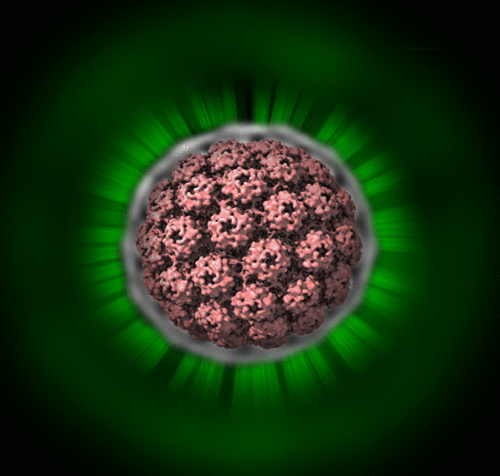
Liam Scott, a trainee in the Zlotnick lab, has co-authored an ACS Nano study, titled Genetically Engineered Multichromophore Virus-Like Nanoparticles with Ultranarrow Distribution of Emission Intensity. The research, in collaboration with the Dragnea lab (another QCB trainee lab), demonstrates an approach to creating ultra-bright, uniform fluorescent nanoparticles using engineered viral capsid proteins. This work bridges virology, nanotechnology, and advanced imaging techniques, showcasing how viral assembly mechanisms can be repurposed for next-generation optical tools. Congratulations to Liam and the team on this contribution to nanotechnology and synthetic biology!
Hunter Richman, a trainee in the Yu Lab, is authored on a recent publication in Nano Letters titled “Targeting the Weak Spot: Preferential Disruption of Bacterial Poles by Janus Nanoparticles.” Their work demonstrates that high-curvature regions of bacterial cell walls are “weak spots” for Janus nanoparticles, thereby aiding the development of more effective targeted therapies. Congratulations Hunter on this work!
Andrew Bach, a trainee in the Snaddon Lab, is authored on a recent publication in Helvetica Chimica Acta titled “En Route to Enantioenriched Quaternary Stereocenters via LewisBase/Palladium Cooperative Catalysis.” They describe a cooperative isothiourea Lewis base-palladium catalyst system that enables the enantioselective alkylation of α-substituted-α-cyano esters with allyl methanesulfonate. Their study represents the first time they have successfully constructed quaternary-substituted stereogenic centers using this Lewis base-palladium cooperative catalysis scheme. Congratulations Andrew on this work!